Table of Contents
- Assess Current Railing Hazards for Young Children
- Reduce Gaps Between Balusters and Vertical Bars
- Install a Childproof Railing Guard to Block Climbing
- Add Mesh, Netting, or Clear Panels for Horizontal Railing Child Safety
- Install a Child Safety Gate for Metal Railings
- Perform Metal Railing Inspection and Maintenance for Safety
- When to Replace Rather Than Retrofit Your Railings
- Frequently Asked Questions
Last Updated: October 12, 2026
Assess Current Railing Hazards for Young Children
Making metal railings safer children starts with understanding the dangers on your property. A railing that looks secure to an adult can present serious climbing and fall hazards to a curious toddler, because gaps between balusters, horizontal rails, and decorative metalwork give small hands and feet purchase.
Examine your railings from a child’s height: check for openings they could fit through or climb, balusters spaced too far apart, horizontal rails that create footholds, and sharp edges or finials.
Age-Specific Risk Assessment
Each stage presents different hazards:
- Crawling infants (6-18 months): Focus on entrapment. Check for openings between 5 cm and 10 cm where a head could wedge but hips could pass through, and gaps at the base where a baby could crawl under.
- Toddlers (18 months-3 years): Climbing is the primary risk. Horizontal rails, decorative scrolls, and even closely spaced vertical bars provide footholds. Ensure no horizontal element sits within 60 cm of the floor or a landing surface.
- Older children (3-6 years): They may squeeze through or climb over. Check that railing height is sufficient (typically 110 cm for balconies and landings under UK Building Regulations) and that no climbable features exist on the child’s side.
UK Regulatory Context
In the UK, Approved Document K (Protection from falling, collision and impact) sets out guarding requirements. For new builds and major renovations, minimum guarding height for a balcony or landing is 1100 mm, and baluster gaps should not allow a 100 mm sphere through. These rules apply mainly to new construction but are a useful benchmark for existing railings, which warrant closer inspection if they predate current standards.
Measurable Checks
Use a tape measure and a sphere (a tennis ball is about 6.7 cm) to test openings: any gap that lets a 10 cm sphere through is a potential entrapment hazard. Also check:
- Railing height: Measure from the floor or landing to the top of the railing. For elevated areas, 1100 mm is the standard minimum.
- Horizontal rails: Identify any horizontal member that could serve as a step. If it is within 60 cm of the floor, it is a climbing risk.
- Sharp edges and points: Run your hand along the railing (carefully) to feel for burrs, sharp welds, or protruding finials. These can cause cuts or catch clothing.
Photograph problem areas and note measurements to plan improvements and brief contractors.
Start at the top of the railing and work down. Children often climb from a standing position, so the lower half of a railing typically poses the greatest risk. Pay special attention to any section within arm’s reach of a landing, balcony, or stairs.
If you find significant corrosion, missing sections, or a railing that moves when pushed, do not attempt DIY fixes. Structural failure is a serious risk and requires professional assessment.
Reduce Gaps Between Balusters and Vertical Bars
Baluster spacing is critical: bars too far apart let a child squeeze through or wedge their head, creating entrapment and fall risks. No opening should allow a sphere larger than 10 centimetres through, roughly the size of a young child’s head. If your balusters exceed this, reduce gaps by:
Add additional balusters. Install new vertical bars between existing ones to halve the gap. This requires welding and is best handled by a professional metalworker who can match materials and finishes.
Install vertical mesh or netting. Stretch a taut mesh panel across the interior face, secured with stainless steel fasteners or cable ties, preserving sightlines while blocking access.
Fit clear polycarbonate or acrylic panels. Transparent barriers allow visibility while preventing climbing, mounted on the interior or exterior with brackets and fasteners.
Use horizontal cable systems. Stainless steel cables spaced 10 centimetres apart create a flexible barrier that is difficult for children to climb.
The most effective solution combines multiple barriers. A railing with reduced gaps, smooth finishes, and a secondary guard is significantly safer than any single modification alone.
Install a Childproof Railing Guard to Block Climbing
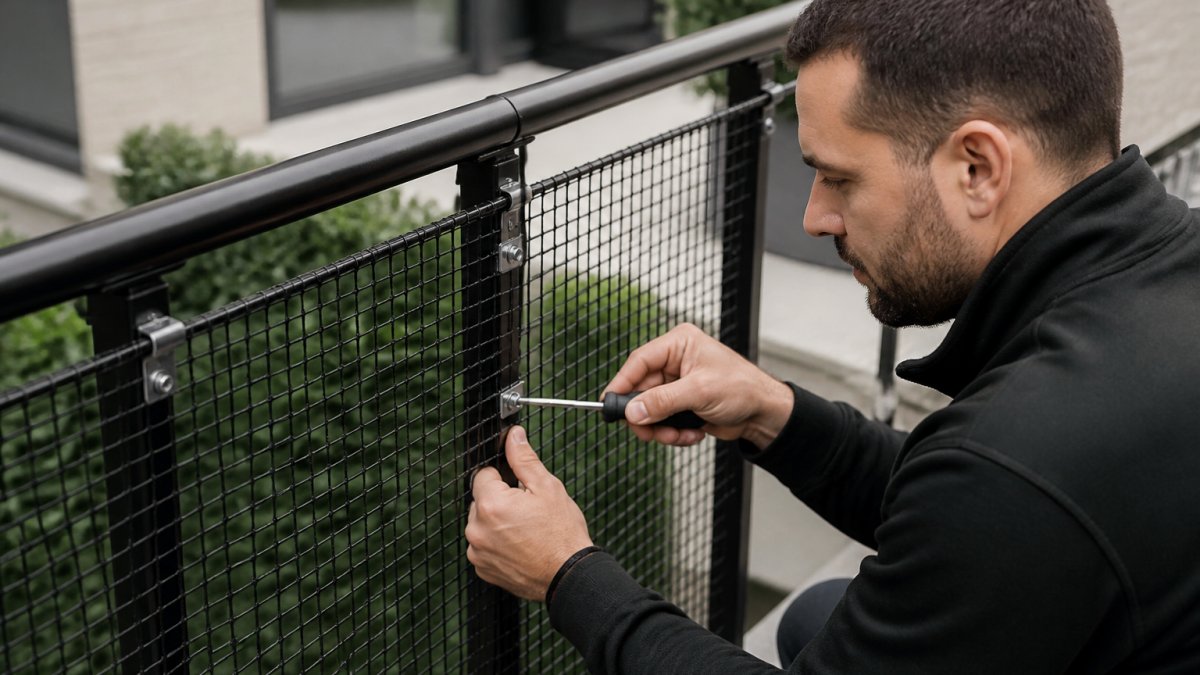
A childproof railing guard is a secondary barrier covering the climbable parts of your existing railing, ideal when you cannot or do not want to permanently modify the original metalwork. Guards are typically rigid mesh, polycarbonate sheets, or expanded metal, mounted flush against the interior face with brackets, fasteners, or adhesive, and should extend from the base to at least 1.5 metres to prevent children reaching over the top. Installation steps:
- Measure the full height and width of the railing section to protect.
- Select a guard material to suit your aesthetic and budget: mesh is affordable and functional, clear panels offer better views, expanded metal is decorative.
- Clean the railing surface of dirt, rust, or loose paint.
- Attach mounting brackets every 30-45 centimetres.
- Secure the panel with stainless steel fasteners to resist corrosion.
- File or cover sharp edges where the guard meets the frame.
- Test with firm downward and outward pressure to ensure it does not flex excessively.
Never use soft or flexible materials like fabric or thin plastic. Children can push through or tear them, creating false security. Rigid materials like mesh, polycarbonate, or expanded metal are far more reliable.
Add Mesh, Netting, or Clear Panels for Horizontal Railing Child Safety
Horizontal rails create natural footholds and handholds, letting a child step up the bars like a ladder, turning the railing into a climbing structure rather than a barrier.
Blocking horizontal access requires a barrier covering the interior face so a child cannot grip or step on the horizontal elements.
Clear polycarbonate or acrylic panels maintain views through the railing.
Netting systems suit temporary use only: choose high-strength marine-grade netting rated for outdoor use and anchor it securely so children cannot pull it loose.
When installing any barrier, ensure:
- No gaps larger than 10 centimetres between the barrier and the railing frame
- All fasteners are stainless steel or galvanised to resist corrosion
- The barrier extends the full height of the railing
Test the barrier by trying to push a tennis ball through any opening. If the ball fits, a child’s head could become trapped. Adjust fastener placement or add additional securing points until no gaps remain.
Install a Child Safety Gate for Metal Railings
A child safety gate provides a controlled access point and prevents unsupervised entry to areas protected by metal railings, essential for balconies, stair landings, and outdoor areas.
Hardware-mounted gates are bolted or welded directly to the railing: permanent, secure, and meeting higher safety standards, they cannot be accidentally dislodged.
When choosing a gate:
- Select one with vertical bars spaced no more than 10 centimetres apart
- Ensure the gate swings freely and latches securely in both directions
- Check that the latch mechanism is out of reach of small hands
Install the gate at the top of stairs, at the entrance to a balcony, or at any transition between protected and unprotected areas.
Perform Metal Railing Inspection and Maintenance for Safety
Regular inspection catches hazards before they become dangerous. Check thoroughly at least twice a year, and more often in harsh weather or heavy use. Look for:
Structural damage. Check for bent, cracked, or missing sections. Loose bolts or welds indicate structural failure and require immediate professional repair.
Corrosion and rust. Surface rust is cosmetic, but deep pitting weakens the metal and creates sharp edges.
Loose fasteners. Tighten any bolts, screws, or cable ties.
Sharp edges. Run your hand along the railing to feel for burrs, sharp welds, or exposed edges.
Coating damage. Powder-coated or galvanised finishes protect the underlying metal. Chips or peeling expose steel to corrosion.
Guard and barrier condition. Check that mesh is taut, panels are secure, and fasteners are tight.
Maintenance is cheaper than replacement. A railing that receives regular cleaning, rust treatment, and fastener checks can last 20-30 years. Neglected railings deteriorate rapidly and become unsafe.
When to Replace Rather Than Retrofit Your Railings
Sometimes modifying an existing railing is less practical or safe than replacement. Use the framework below to assess your options, including material trade-offs and cost-influencing factors.
Decision Framework: Retrofit vs Replace
If any trigger below applies, replacement is likely the better long-term choice.
Replace your railings if:
- Structural integrity is compromised. Deep corrosion, missing sections, cracked welds, or significant movement when pushed indicate the railing cannot safely support weight. Retrofitting a weak structure is false economy and may void any warranty.
- The design is inherently unsafe. Widely spaced balusters (over 100 mm), horizontal rails within 60 cm of the floor, or sharp decorative elements are hard to modify without major reconstruction; a new railing designed with safety in mind is often more cost-effective than extensive retrofitting.
- The railing is beyond its serviceable life. If the finish is failing widely, rust is pervasive, or fasteners are corroded beyond tightening, replacement beats ongoing repairs.
Retrofit your railings if:
- The structure is sound. If the railing is structurally intact and corrosion is minimal, modification is worthwhile.
- The railing has historical or architectural value. Victorian or Edwardian metalwork is often worth preserving. Careful retrofitting maintains character while improving safety.
- Budget constraints are tight. A well-executed retrofit costs less than replacement and improves safety immediately.
Material Trade-Offs for Retrofitting
When retrofitting, the material you choose affects durability, visibility, maintenance, and reversibility. The following table summarises common options.
| Material | Durability | Visibility | Maintenance | Reversibility | Suitability |
|---|---|---|---|---|---|
| Galvanised steel mesh | High | Moderate | Low | Moderate | Outdoor, permanent |
| Stainless steel mesh | Very high | Moderate | Very low | Moderate | Outdoor, coastal |
| Polycarbonate panels | Moderate | High | Low | High | Indoor/outdoor, temporary |
| Acrylic panels | Moderate | High | Low | High | Indoor, low-impact |
| Marine-grade netting | Low | High | Moderate | High | Temporary, indoor |
| Additional balusters (welded) | Very high | High | Very low | Low | Permanent, matches existing |
Galvanised steel mesh balances strength and cost for most outdoor railings, though cut edges need periodic rust inspection.
Acrylic panels are clearer than polycarbonate but more brittle, best for indoor use or areas protected from impact.
Additional balusters welded between existing ones are the most permanent, seamless option, requiring professional welding and refinishing to match the existing coating.
Cost Factors
The cost of retrofitting or replacing railings depends on several factors:
- Size and complexity: Longer runs and intricate designs require more labour and materials.
- Material choice: Stainless steel and specialist coatings cost more than mild steel and standard powder coating.
- Finish: Powder coating, galvanising, or a combination adds to the cost but improves durability.
Request a bespoke quote after a site survey for an accurate assessment of your railings.
When to Call a Professional
If you are unsure about the structural condition of your railings, or lack the tools and experience to weld or install barriers safely, consult a professional metalworker who can assess the railing, recommend the right solution, and work to current safety standards.
At Metal Railings London, we assess each railing individually to determine whether retrofit or replacement is the right approach. Our team examines structural condition, material quality, and design safety to recommend the most practical solution for your property.
Retrofitting is usually the faster and cheaper option for sound railings, but replacement is safer and more cost-effective when the structure is compromised or the design is fundamentally unsafe. A professional assessment removes the guesswork.
Frequently Asked Questions
What size gaps in metal railings are unsafe for young children?
Building Regulations require that vertical bars on railings protecting children under 5 years old must be spaced no more than 100 millimetres apart. Horizontal rails that are climbable present a separate risk. Any opening larger than 100 millimetres should be treated as a hazard. If your existing railing has wider gaps, you’ll need to retrofit it with mesh, netting, or additional vertical elements to meet safety standards and prevent a child from passing through or becoming trapped.
How do I install a childproof railing guard on metal railings?
A childproof railing guard is typically a flexible mesh, acrylic panel, or polycarbonate sheet secured to the existing railing with corrosion-resistant fasteners or cable ties. Measure the height and width of the area to be covered, then attach the guard material securely so there are no loose edges a child can grab or slip under. The guard should extend at least 1.2 metres high and cover all climbing-accessible surfaces. Ensure fasteners are tight and smooth, with no sharp protrusions. Professional installation ensures the guard is structurally sound and meets safety requirements.
Are horizontal metal railings safe for young children?
Horizontal rails create a climbing hazard for young children because they act like ladder rungs. If your railing has horizontal elements spaced closely enough for a child to grip, you must modify it by adding vertical mesh or netting to prevent climbing access. Alternatively, you can install a childproof guard that covers the horizontal rails entirely. This is why many modern railings designed for family homes use vertical balusters instead, they eliminate the climbing hazard while maintaining visibility and aesthetic appeal.
How often should I inspect metal railings for child safety?
Inspect your metal railings at least twice yearly, and after any severe weather or impact. Check for loose balusters, rust or corrosion that weakens the structure, sharp edges or pointed finials that could injure a child, gaps that have widened, and any damage to mesh or panel guards. Ensure all fasteners are tight and that the railing doesn’t move when pushed firmly. If you notice structural movement, rust penetration, or any component that feels unstable, arrange professional inspection and repair immediately. Regular maintenance prevents small issues from becoming safety hazards.