Last Updated: October 23, 2026
Quick Summary
How to prevent rust on metal railings involves removing moisture exposure, applying a rust-inhibiting primer and quality exterior topcoat, and inspecting regularly for coating damage. Match the protection system to your metal type, galvanised steel, stainless, wrought iron or aluminium each need different approaches, and seal joints and fixings where water collects first.
- Rust forms where moisture contacts bare metal; coastal railings and shaded positions corrode faster than sheltered inland ones.
- Surface preparation is critical: clean thoroughly, remove existing rust with wire brush or sanding, and never paint over loose coatings or dirt.
- Apply a rust-inhibiting primer to bare metal, then exterior-grade topcoat in thin, even layers; powder coating offers superior durability in harsh environments.
- Inspect railings twice yearly to quarterly depending on exposure; act immediately on rust breakthrough, chipped coating or cracked sealant.
- Galvanised railings need annual inspection and spot-priming of bare spots, but avoid abrasive cleaning that strips the protective zinc layer.
Table of Contents
- Why Metal Railings Rust and How to Stop It
- How to Clean Metal Railings Before Treatment
- How to Remove Rust from Metal Railings
- Best Paint for Metal Railings and Protective Coatings
- Galvanised Metal Railings Maintenance and Long-Term Protection
- Creating a Maintenance Schedule to Prevent Future Rust
- Common Mistakes to Avoid When Protecting Metal Railings
- Frequently Asked Questions
Why Metal Railings Rust and How to Stop It
Rust forms when metal meets moisture and oxygen. At Metal Railings London, we work with these materials daily and know how to prevent rust on metal railings before it starts.
Understanding moisture exposure and corrosion
Water sits on your railing, seeps into crevices and triggers oxidation.
Coastal railings corrode faster than inland ones, shaded railings stay damp longer, and high-traffic railings collect dirt that traps moisture.
Without a protective barrier, corrosion is inevitable, understanding how to prevent rust on metal railings means every railing needs a proper coating system.
The role of bare metal and flaking paint
When paint or powder coating chips away, fresh metal is exposed, and a single scratch can become a rust hotspot within weeks.
Flaking paint traps moisture under the loose coating, so damage often runs deeper than the visible flakes suggest.
Surface preparation matters: you cannot simply paint over rust or failing coatings, or the new layer will fail just as quickly.
How to Clean Metal Railings Before Treatment
Proper cleaning determines whether your protective coating will stick and last.
Degreasing and removing dirt buildup
Remove loose debris with a stiff brush, especially at joints and corners where dirt collects.
Degrease with a metal-appropriate product, then wipe clean, oil and grease prevent coatings from bonding.
For stubborn grime, use a pressure washer on low pressure, then let the railing dry completely.
Inspecting for existing rust and damage
Check joints, welds and areas where water pools, these rust first.
Note the extent of rust damage:
- Surface rust appears as light orange or brown discoloration
- Deep pitting means corrosion has eaten into the metal
- Flaking paint indicates failure underneath
This tells you whether light surface treatment or aggressive rust removal is needed; deep or widespread rust may require professional restoration.
Check for loose bolts, cracked welds or structural damage, rust weakens integrity, so if the railing feels unstable, stop and consult a professional.
How to Remove Rust from Metal Railings
Once you’ve cleaned the surface, tackle any existing rust.
Sanding and wire-brushing techniques
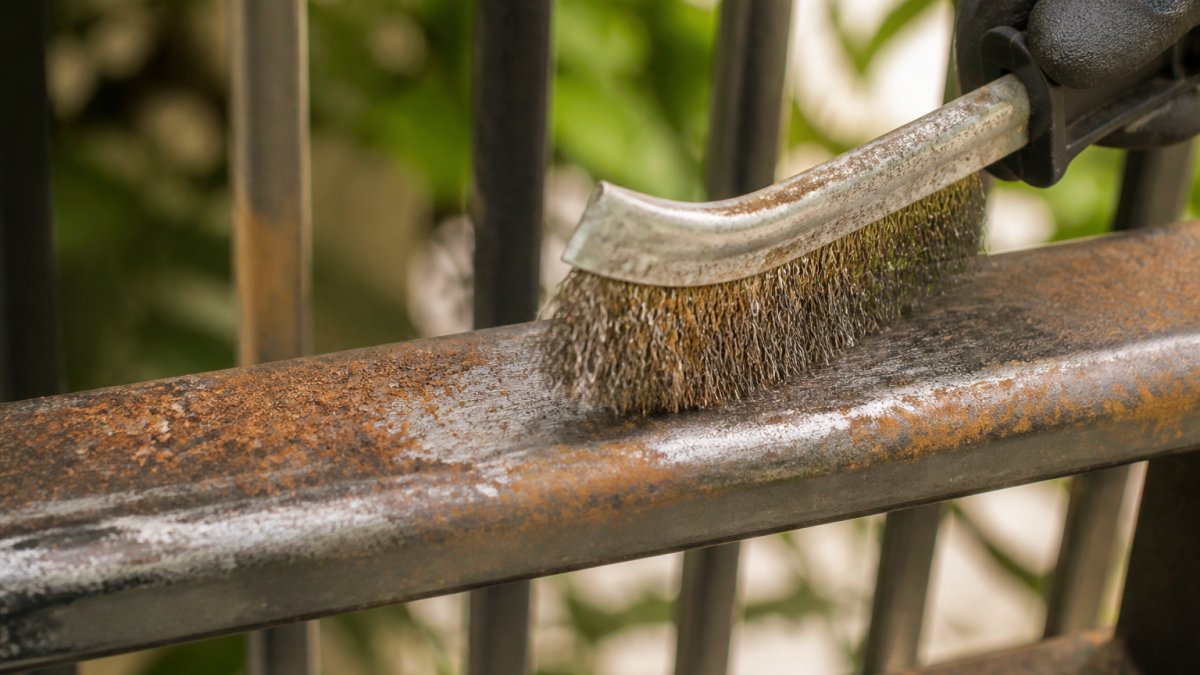
For light surface rust, scrub firmly with a wire brush in circular motions, without gouging the metal.
For heavier rust, sand from coarse (60-80 grit) through medium (120-150) to fine (220+).
Work systematically, light sanding everywhere ensures the coating bonds evenly.
Wear gloves and eye protection, and work outdoors or in a well-ventilated area.
Using rust converters and chemical treatments
Apply per the product instructions; most need a few hours, after which the treated rust darkens and hardens into a base for primer and paint.
Chemical treatments are an alternative, some dissolve rust, others neutralise it, chosen by rust severity and material.
After treatment, the surface must be clean and dry, as residue interferes with paint adhesion.
Best Paint for Metal Railings and Protective Coatings
The right coating system makes the difference between a railing that lasts five years and one that lasts twenty.
Choosing rust-resistant paint and primer systems
Start with a rust-inhibiting primer that bonds to bare metal and contains rust-fighting compounds to prevent corrosion beneath the paint.
Apply primer per the manufacturer’s instructions and allow proper drying time, rushing weakens the entire system.
For the topcoat, use exterior-grade metal paint formulated for railings, which offers better adhesion, flexibility and weather resistance than generic options.
Apply thin, even coats rather than one thick coat, allowing proper drying time between layers.
Powder coating versus traditional paint finishes
It excels in harsh environments, resisting salt spray, UV and weather better than paint, and resists chipping and scratching.
Paint offers easier touch-up and on-site application, whereas powder coating requires specialist equipment.
We recommend powder coating when feasible for its superior durability; otherwise, high-quality exterior metal paint provides solid protection when applied correctly.
Galvanised Metal Railings Maintenance and Long-Term Protection
Galvanising, coating steel with zinc, is one of the most effective corrosion defences for exterior railings, but it is not fit-and-forget, and the care regime differs by material.
Understanding galvanizing and zinc coatings
Hot-dip galvanising immerses fabricated steel in molten zinc, forming a bonded coating far thicker and harder than paint.
Inspect galvanised railings at least annually. A dull grey patina and light white zinc oxide deposits are normal; bare steel showing through, brown staining at edges or heavy white build-up in crevices are not.
Galvanised surfaces need a suitable primer before painting, ordinary metal paint often will not adhere to fresh zinc. Allow the galvanising to weather for a few months, or use a specialist etch primer, before applying a topcoat.
Material-specific prevention: iron, steel, stainless and aluminium
Match the approach to the metal:
- Wrought iron and mild steel, the most vulnerable to rust once the coating fails. They need a full system: rust removal, rust-inhibiting primer, and a durable topcoat or powder coat. Touch up chips promptly; a single exposed scratch will bloom within weeks in damp conditions.
- Galvanised steel, the zinc does the work, so avoid abrasive cleaning that strips it. Do not apply acid-based rust converters to intact galvanising; they attack the zinc. Use a clear protective coating if you want to slow weathering.
- Stainless steel, highly corrosion-resistant but not immune, particularly near the coast or where chlorides (including household cleaning products) are present. Clean with fresh water and a mild detergent, and avoid wire brushes that have been used on carbon steel, which can transfer iron particles and trigger surface rust.
If unsure what your railing is made of, a fabricator can identify it quickly, mistaking stainless for mild steel, or vice versa, is a common and costly error.
Protecting joints, water traps and fixings
Corrosion rarely starts mid-section; it starts where water collects, welds, bolted or riveted joints, the base where the railing meets stone or paving, fixing holes and crevices. Inspect and seal these first.
Seal open joints with a waterproof sealant rated for exterior metal, reapplying every two to three years or sooner if it cracks or lifts. Ensure the railing sheds water, a slight fall on horizontal rails and clear drainage at the base make a real difference. Where a railing is set into a wall or plinth, check the fixing pocket doesn’t hold water; a weep hole or sealed base plate prevents the slow corrosion that loosens the whole run.
Safety and repair thresholds
Rust is not only cosmetic. Deep pitting, thinning sections, cracked welds or movement at the base can mean the railing no longer meets its structural purpose, for balustrades and guarding, a safety issue governed by UK Building Regulations.
Older railings may carry lead-based paint: assume any pre-1980s coating could contain lead, avoid dry sanding, wear respiratory protection and consider a professional assessment.
If a railing guards a drop, a stair or a public edge, structural integrity is not optional. Deep corrosion or loose fixings should be professionally assessed rather than patched.
For galvanised railings, a clear protective coating over the zinc slows weathering; recoat every five to seven years, or sooner in coastal or heavily shaded positions.
Creating a Maintenance Schedule to Prevent Future Rust
A maintenance schedule only works if matched to exposure and coating condition. Build it around three variables: how wet the location stays, how much salt or pollution the air carries, and how sound the existing finish is.
Setting an inspection cadence by exposure
Use this as a starting framework, then adjust to what you find:
- Sheltered inland positions (porches, courtyards, under eaves), inspect twice a year, in spring and autumn. These dry out quickly and corrode slowly.
- Typical exposed urban positions (street frontages, garden boundaries), inspect quarterly. Pollution and rain keep surfaces damp for longer.
- Coastal or persistently damp positions (within reach of salt spray, heavy shade, north-facing), inspect every six to eight weeks during wetter months. Salt and constant moisture accelerate corrosion markedly.
Inspect after any severe weather regardless of schedule, freeze-thaw cycles, driving rain and storms open coatings and trap water.
What to check and when to act
At each inspection, run a hand along rails for roughness or blistering, check welds, joints, fixings and the base for brown staining, confirm sealant is intact and the railing firm. Record findings to spot deterioration over time.
Act on the following triggers rather than waiting for a fixed date:
- Any rust breakthrough, treat and spot-prime immediately; small spots expand quickly once moisture reaches bare steel.
- Chipped or flaking coating, clean back to sound coating, feather the edges, and recoat. Do not paint over loose material.
- Cracked or lifting sealant at joints, remove and reseal before the next wet season.
Coating compatibility and recoating
Recoating is where many maintenance regimes fail, because not all products layer together:
- Apply a rust-inhibiting primer to bare metal before any topcoat; topcoat alone will not stop corrosion.
- Match the topcoat to the primer system, use products from the same manufacturer or a system the manufacturer confirms is compatible.
- Do not apply a hard topcoat over a soft or incompatible base; the layers will move differently and fail.
Plan a full recoat every five to seven years in typical conditions, sooner in coastal or heavily exposed positions. Before recoating, clean thoroughly, remove loose material, sand to key the surface, spot-prime bare areas and apply thin, even coats.
| Maintenance Task | Typical Frequency | Best Time |
|---|---|---|
| Visual inspection | Twice yearly to quarterly, by exposure | Spring and autumn |
| Deep clean | Annually | Spring |
| Sealant check and reapplication | Every 2-3 years | Autumn, before wet weather |
| Spot priming and touch-up | As soon as rust or chips appear | Any dry spell |
| Full recoat | Every 5-7 years, sooner if exposed | Spring |
| Structural check of fixings and base | Annually | Spring |
The most reliable prevention is not a fixed calendar but a condition-led habit: inspect often, act on the first sign of rust or coating failure, and keep joints and fixings sealed. That approach outperforms any single product.
If you would rather not manage this yourself, a fabricator can carry out a site survey, identify the material and coating system, and recommend a maintenance plan suited to your property.
Common Mistakes to Avoid When Protecting Metal Railings
Don’t skip surface preparation, painting over dirt or failing coatings guarantees early failure.
Don’t use cheap paint, budget exterior paint fails faster, while quality coatings last significantly longer.
Don’t apply thick coats. Multiple thin coats outperform one thick coat.
Don’t mix coating systems carelessly, ensure primer and paint are compatible, as some combinations won’t bond properly.
Metal railings are an investment in your property’s security and aesthetics.
At Metal Railings London, we design and install railings built to last, with galvanised and powder-coated finishes providing exceptional corrosion resistance for decades.
Frequently Asked Questions
Can galvanised railings rust even with a protective coating?
Galvanised railings are highly rust-resistant due to their zinc coating, but they can still corrode if the galvanising is damaged or if water pools at joints. Chipped paint or powder coating can expose the zinc layer underneath, allowing moisture to reach the underlying metal. Regular inspection and prompt recoating of any damaged areas will keep galvanised railings protected for decades.
How often should metal railings be repainted to prevent rust?
Most metal railings benefit from inspection every 6-12 months, depending on exposure to salt spray, moisture, and weather. If you notice flaking paint, scratches exposing bare metal, or early rust spots, recoat immediately. In harsh coastal conditions or areas with high humidity, annual repainting may be necessary. A quality rust-resistant paint system can extend intervals between recoats.
What is the best coating to prevent rust on outdoor railings?
Powder coating offers superior durability and rust protection compared to traditional paint, with a harder, more uniform finish that resists chipping and moisture infiltration. For maximum protection, apply a rust-converting primer to bare metal before the topcoat. Galvanising combined with powder coating provides the longest-lasting protection, as the zinc layer stops corrosion even if the paint is scratched.
Is there something I can apply to metal to prevent rust without painting?
Wax-based metal sealants and oils can provide temporary protection and are useful for maintenance between full recoats, but they do not offer the same long-term rust prevention as paint or powder coating. They require frequent reapplication and work best as a supplementary protective measure. For permanent rust prevention, a proper primer and paint system or galvanising is essential.
