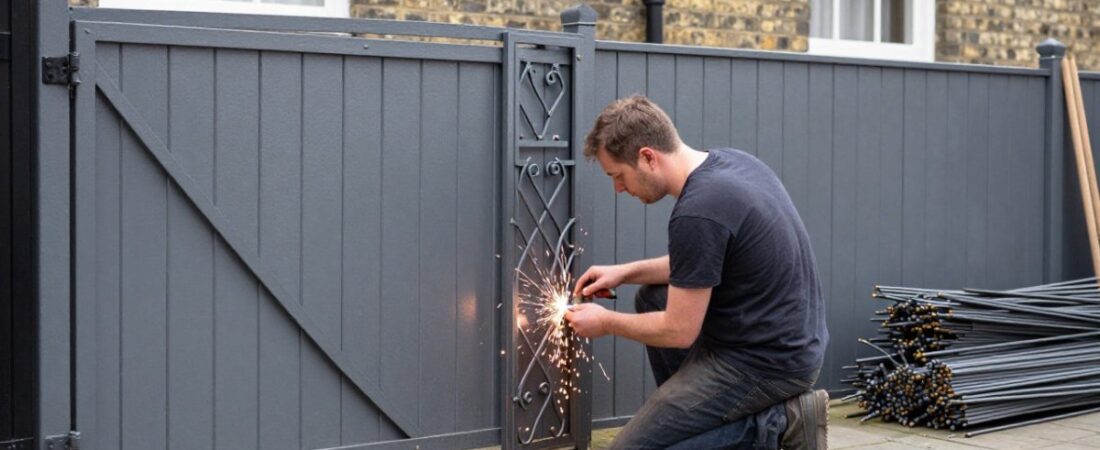
Last Updated: November 12, 2026
Quick Summary
Custom decorative steelwork is metal made to the exact dimensions, style and job a garden needs, such as privacy screens, boundary panels, planters, arches and sculptural pieces. Steel holds a crisp line, can be cut into thin profiles, and with the right finish can withstand London weather for years.
- Bespoke screens can use leaf, geometric or abstract patterns that let light through while blocking sightlines.
- Ask for a full-size mock-up or detailed drawing to judge how a pattern reads at actual scale.
- Hot-dip galvanising protects steel, and fabricators should state the coating thickness on the drawing.
- Drill and cut holes before galvanising, since later work exposes bare steel and can void the coating.
- Cost depends on size, material, gauge, finish, design complexity and installation access, so request an itemised quote.
Table of Contents
- Why Custom Decorative Steelwork Suits Garden Spaces
- Bespoke Metal Garden Screens for Privacy and Style
- Decorative Steel Garden Panels as Living Walls and Fences
- Galvanised Steel Garden Features and Their Lifespan
- Powder-Coated Garden Steelwork: Finishes and Colour Options
- Planters, Arches and Sculptural Pieces
- Factors That Affect the Cost of Bespoke Garden Steelwork
- Booking a Site Survey and Requesting Your Bespoke Quote
- Frequently Asked Questions
Why Custom Decorative Steelwork Suits Garden Spaces
Custom decorative steelwork gives a London garden something mass-produced ornaments cannot: a piece made to the exact dimensions, style and job it has to do. Bespoke garden steelwork can be designed and fabricated around the space it will occupy, so nothing has to be squeezed to fit.
Steel suits outdoor use for practical reasons. It holds a crisp line, it can be cut and welded into thin profiles, and with the right finish it can stand up to London weather for years. Decorative work also doubles as privacy, shelter and boundary, which means one piece can replace a fence panel and a feature wall at the same time.
A piece designed for its setting from the start is more likely to suit the space. A narrow courtyard, a Victorian terrace garden and a modern roof terrace each call for different scale, density of pattern and fixing method.
Bespoke Metal Garden Screens for Privacy and Style
A garden screen is usually the first custom piece homeowners ask about, because it solves an immediate problem: overlooking neighbours, wind or a view that needs softening. Bespoke screens can be cut with leaf, geometric or abstract patterns that let light through while blocking sightlines.
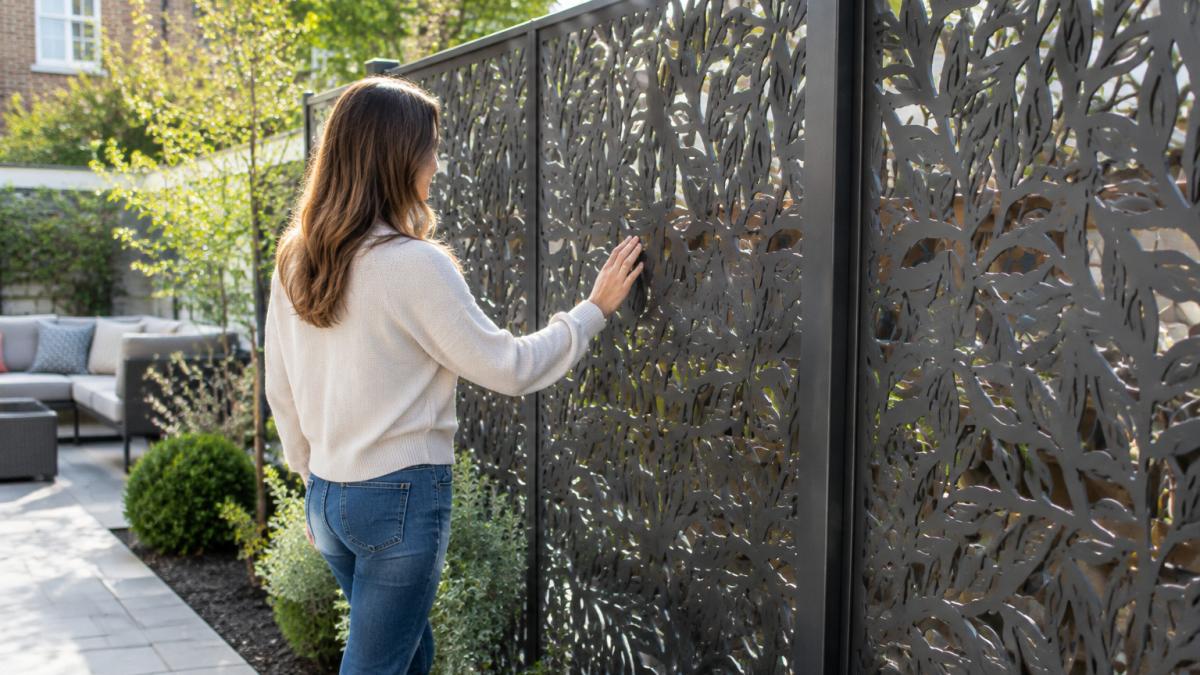
Pattern density controls privacy. A tight pattern hides a seating area completely, while an open pattern filters the view and casts shadows across paving.
A common mistake is choosing a pattern on a small sample and assuming the same look at full scale. Ask for a full-size mock-up or a detailed drawing with the pattern shown at the actual size, so you can judge how it reads against the planting and the house behind it.
Decorative Steel Garden Panels as Living Walls and Fences
Decorative panels can work as boundary fences, living walls or backdrops for climbing plants. Steel can support trellis-style growth, and a panel fixed a few centimetres off a wall lets air circulate.
For fencing, panel thickness and post spacing matter more than the design. Heavier gauge steel resists flex in wind, and posts set into a concrete footing at the right depth keep the line straight over years. Ask for the fixing method in writing before you agree the design.
Living walls need a little planning. Plants need access for watering and pruning, so leave a clear gap at the back of the panel and choose a mounting that lets you lift or remove sections if needed.
Galvanised Steel Garden Features and Their Lifespan
Hot-dip galvanising immerses prepared steel in molten zinc, forming a coating that protects the steel both as a barrier and by sacrificial action.
Galvanised coatings are typically specified by zinc thickness, and a fabricator should be able to state the coating thickness on the drawing.
Lifespan is governed by how quickly the zinc is consumed. The main drivers are:
- Time of wetness: Steel that stays wet for long periods corrodes faster than steel that dries out between showers. A feature on a drained patio lasts longer than one standing in persistently wet soil.
- Airborne chlorides: Coastal and estuarine locations, and gardens near busy treated roads, accelerate zinc consumption.
- Soil contact: Burial in soil is more aggressive than atmospheric exposure, so posts set into the ground benefit from a heavier coating or a protective sleeve.
- Surface contamination: Fertiliser, compost and some timber treatments can attack the coating if they sit against the steel.
Galvanised steel does not last indefinitely, and a common pattern is for the coating to weather to a uniform matt grey before any underlying steel is exposed. Inspect the piece periodically, particularly at ground level and where water can collect. Avoid abrasive cleaning that removes the zinc layer.
Galvanising also suits pieces that will be finished later. A powder-coated finish over galvanised steel can combine zinc protection with a colour and texture of your choice.
Drilling, cutting or welding after galvanising exposes bare steel and can void the coating at that point, so fabrication and drainage holes are best completed before coating.
Powder-Coated Garden Steelwork: Finishes and Colour Options
Powder coating applies a dry polymer powder and cures it to form a finish. Colour, gloss and texture can be chosen to suit the design.
Finish choice affects both look and upkeep. Matt and textured powders hide minor marks better than gloss, while gloss finishes give a sharper modern line. Darker colours absorb more heat in direct sun, which is worth considering for pieces near seating or children’s play areas.
Powder coating can chip if struck hard during installation. Ask how the piece will be protected in transit and on site, and whether touch-up is supplied for any damage that occurs during fixing.
Planters, Arches and Sculptural Pieces
Planters, arches and sculptural pieces bring height, rhythm and focus to a garden. A steel arch can frame a path or entrance, a planter can add structure to a patio, and a silhouette sculpture can anchor a border without needing soft planting to hold it up.
Design these pieces around how they will be used. Planters need drainage holes and a liner or a gap to stop soil sitting directly on steel. Arches need footings that resist the load of climbing plants when they are mature. Sculptures should be scaled to the sightline from the house or the main seating area, not just to the piece in isolation.
For sculptural work, discuss the viewing angles early. A piece that looks striking from the kitchen window may need a different back or base treatment if it will also be seen from the lawn.
Factors That Affect the Cost of Bespoke Garden Steelwork
Pricing depends on the specification of each piece, so there are no fixed prices on this page. What we can do is explain how each factor drives cost, so you can judge a quote on its merits rather than on the headline figure alone.
- Size and quantity: Cost scales with surface area and weight, not just with the number of panels. A tall screen needs heavier section steel and more fixings than a low one, and repeated identical panels cost less per unit than one-offs because cutting and setting-up time is shared. Odd dimensions that fall outside standard sheet sizes generate more waste.
- Material and gauge: Standard mild steel is the most economical choice. Stainless steel costs more in material and in working time, because it needs different cutting, welding and finishing consumables. Thicker gauge adds weight, which increases handling, transport and fixing requirements as well as material cost.
- Finish: A single powder coat is the least processed option. Hot-dip galvanising followed by powder coating involves two separate processes, extra handling and a longer lead time, and it is priced accordingly. Specialist colours, metallic effects and textured powders sit above standard colours.
- Design complexity: Simple geometric patterns cut quickly. Dense, fine laser-cut patterns take longer on the machine, generate more heat distortion to manage, and may need hand finishing to remove dross. Hand-forged or hand-finished details add skilled labour hours that are not visible in the drawing.
- Installation access: Narrow side passages, steep gardens, upper-floor balconies and restricted parking all add labour and sometimes lifting equipment. A piece that can be carried through in sections and assembled on site is often cheaper to install than one welded as a single frame.
- Foundations and fixings: Posts set into concrete footings require excavation, concrete and curing time. Structural fixings into masonry may need resin anchors or chemical anchors, and older London brickwork sometimes needs a plate or spreader to distribute the load. Wall-mounted pieces need the wall checked for suitability before the design is finalised.
- Compliance and testing: Where a piece acts as a guard, barrier or boundary near a public footpath, it may need to satisfy UK Building Regulations and relevant British Standards.
These factors combine differently on each project, and a change in one often moves another: a heavier gauge may reduce the number of posts, while a more complex pattern may require a simpler fixing to keep the total build sensible. The most useful step is a bespoke quote based on your measurements and site conditions. Ask any fabricator to itemise their quote so you can see how each factor is priced, and to state what is included in installation and what is excluded.
The main cost drivers for bespoke garden steelwork are summarised below.
| Factor | How it affects cost | Note |
|---|---|---|
| Size and quantity | Cost scales with surface area and weight | Repeated identical panels cost less per unit |
| Material and gauge | Standard mild steel is most economical | Stainless steel costs more; thicker gauge adds weight |
| Finish | Single powder coat is least processed | Galvanising plus powder coating adds a second process |
| Design complexity | Dense fine patterns take longer to cut | Hand-finished details add skilled labour hours |
| Installation access | Narrow passages and steep gardens add labour | Pieces assembled in sections can cost less to install |
| Foundations and fixings | Footings need excavation and curing time | Older brickwork may need plates or spreaders |
Booking a Site Survey and Requesting Your Bespoke Quote
A site survey helps get an accurate design and quote. Measuring the space, checking access and discussing the look you want are useful steps before a design is finalised.
To make the most of a survey, have these details ready:
- Rough dimensions of the area and any height limits
- Photos of the space from the main viewpoints
- The style you prefer, such as traditional, modern or rustic
- Any existing fences, walls or planting to work around
- Your preferred finish and colour, if you have one
Ready to plan your garden steelwork? Get a free quote today to discuss your project. You can also browse our bespoke metal gates and railings for London properties, explore our metal railings range or see our decorative metalwork category for further inspiration.
Frequently Asked Questions
What decorative steelwork can be made for a garden?
Bespoke decorative steelwork for gardens commonly includes privacy screens, boundary and gate panels, planters and raised beds, arches, wall art, and sculptural silhouettes. Designs can be cut, formed and welded to suit the proportions of your outdoor space and the architectural character of your property. Patterns may reflect botanical themes, geometric layouts or simpler contemporary lines. Discussing your site, sightlines and intended use at an early stage helps shape a design that is both attractive and practical for daily use.
Is steel suitable for outdoor garden features?
Steel is well suited to outdoor garden features when it is correctly protected. Untreated mild steel will rust in damp conditions, so it is normally galvanised or powder-coated before installation. Galvanising provides a sacrificial zinc layer, while powder coating adds a durable, weather-resistant finish in a wide range of colours. Together, these protective measures help steel garden screens, planters and panels cope with rain, frost and UK weather when properly cared for.
How should I maintain steel garden features?
Routine maintenance is straightforward. Rinse the surface with clean water periodically to remove dirt, salt and debris, and check fixings and joints each year for any signs of loosening or corrosion. Where a powder-coated finish has chipped, touch it up promptly to prevent moisture reaching the metal. Keep soil and leaf litter from sitting against planters for long periods, as trapped moisture accelerates wear. Avoid abrasive cleaners that can damage protective coatings.
