Table of Contents
- Why Custom Metal Security Gates Matter for Your Property
- Superior Security and Intruder Deterrence
- Custom Steel Security Gates: Tailored Strength for Your Needs
- Wrought Iron Security Gates: Timeless Durability and Elegance
- Galvanised Metal Gates: Long-Term Weather and Corrosion Protection
- Metal Gate Maintenance: Keeping Your Investment Secure
- How Custom Design Enhances Property Value and Curb Appeal
- Choosing the Right Configuration for Your Property
- Frequently Asked Questions
Last Updated: October 19, 2026
Why Custom Metal Security Gates Matter for Your Property
Custom metal security gates combine physical deterrence with aesthetic refinement in a way standard gates cannot. Metal Railings London designs and installs bespoke security installations across residential and commercial properties.
The real value of custom metal security gates lies in addressing your specific security needs while complementing your property’s architectural character, whether you’re protecting a Victorian townhouse, a modern apartment development or a commercial storefront.
Superior Security and Intruder Deterrence
The primary function of any security gate is to prevent unauthorised access. Custom metal security gates do this through deliberately engineered physical barriers that deter intruders far more effectively than decorative alternatives.
A properly designed custom metal security gate combines solid posts, reinforced cross-members, and tamper-resistant fastening systems that resist forced entry.
Psychological deterrence matters equally. An intruder assesses a property within seconds, and a visibly strong custom metal security gate signals that the owner takes security seriously, redirecting most opportunistic attempts toward easier targets. Combined with reinforced locking hardware and access control, it creates layered protection rather than a single point of defence.
Custom Steel Security Gates: Tailored Strength for Your Needs
Custom steel security gates offer unmatched strength, making them the preferred choice for high-security applications. Steel’s tensile strength far exceeds aluminium, so thinner sections achieve greater rigidity without the visual bulk of heavier alternatives.
When we design a custom steel security gate, we begin by understanding your threat profile, casual trespassing, vehicular intrusion or determined forced entry, which determines material gauge, post spacing and locking specification.
The fabrication process for custom steel security gates allows precise engineering that factory-produced gates cannot match.
Steel’s durability under stress is another critical advantage: unlike aluminium, which can deform under impact, steel maintains its structural integrity through repeated stress events.
Wrought Iron Security Gates: Timeless Durability and Elegance
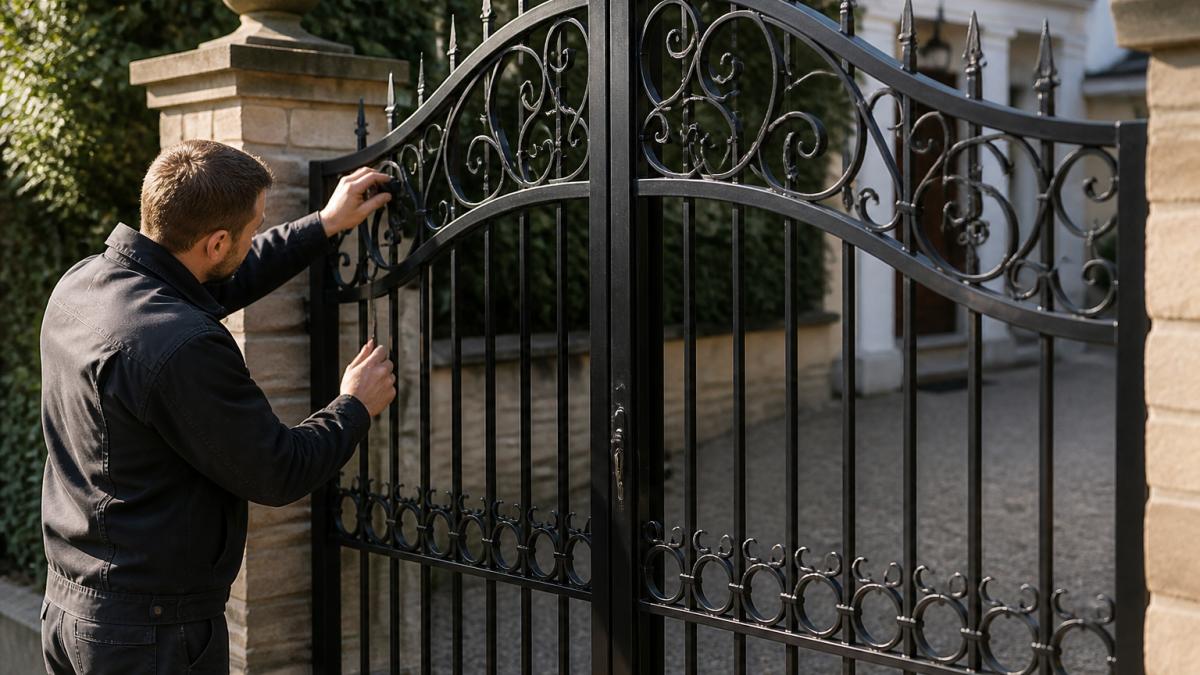
Wrought iron is the traditional choice for high-end custom metal security gates, particularly in period properties and conservation areas, combining exceptional durability with aesthetics that enhance rather than dominate a property’s appearance.
The visual appeal of wrought iron custom metal security gates lies in their ability to complement period architecture authentically. A Victorian property with a modern steel gate looks incongruous; a wrought iron gate with hand-forged details feels like an original feature.
Wrought iron’s longevity is legendary, gates fabricated two centuries ago remain functional today. With appropriate protective coatings, a wrought iron custom metal security gate will outlast multiple generations.
Galvanised Metal Gates: Long-Term Weather and Corrosion Protection
Galvanisation is the most effective corrosion-control measure for custom metal security gates, but the benefit depends on how the coating is specified, finished and inspected. A gate galvanised to the correct standard and powder-coated over a suitable primer will comfortably outlast a painted gate with no zinc barrier, particularly in London’s damp, polluted and occasionally coastal conditions.
What galvanising actually does
Hot-dip galvanising immerses the fabricated steel in molten zinc, forming a metallurgical bond rather than a surface layer. The zinc corrodes preferentially to the steel, so any scratch or chip is protected by the surrounding zinc rather than immediately rusting, which is why galvanised custom metal security gates tolerate knocks and abrasion far better than paint-only finishes.
For security gates, the coating standard matters. Work should be galvanised to BS EN ISO 1461, which specifies minimum zinc coating thicknesses for hot-dip galvanised articles.
Galvanised, then powder-coated: the dual-layer approach
A bare galvanised finish is functional but visually utilitarian. The practical solution for most residential and commercial properties is a duplex system: hot-dip galvanise the steel, apply a zinc-compatible primer, then finish with a polyester powder coat in your chosen colour. The powder coat provides appearance, while the zinc beneath provides the corrosion barrier if the coating is damaged.
This duplex approach is particularly valuable for automated gates, because moving parts and fixings are where coatings fail first. Galvanising the frame, posts and hinge assemblies, then powder-coating visible surfaces, gives the best balance of longevity and design flexibility.
Material-specific corrosion guidance
- Mild steel: Requires galvanising or a high-build protective coating system. Untreated mild steel will corrode quickly outdoors, especially at welds and fixings.
- Stainless steel: Grade 304 is suitable for most inland situations; grade 316 is the sensible choice for coastal or heavily polluted environments where chlorides accelerate corrosion. Stainless steel gates should still be cleaned periodically to remove surface contaminants.
- Wrought iron: Traditional wrought iron relies on paint systems for protection. Modern equivalents are usually galvanised before painting to extend service life.
- Aluminium: Naturally corrosion-resistant but softer; often powder-coated for appearance and additional protection.
Inspection and maintenance schedule
Galvanised gates are not maintenance-free, but the schedule is modest:
- Every six months: Wash down with clean water to remove grime, bird droppings and airborne pollutants that hold moisture against the coating. Check welds, fixings and the base of posts where water collects.
- Annually: Inspect for coating damage, particularly around hinges, locks and ground-level areas. Touch in any exposed zinc with a suitable zinc-rich repair coating.
- Every five to seven years (powder-coated duplex systems): Assess the powder coat for chalking, fading or chipping and arrange recoating where needed. Coastal and industrial exposures may shorten this interval.
When requesting a quote, ask your fabricator to confirm the galvanising standard, the coating thickness and the powder-coat specification. A written specification is the best protection against a finish that looks right on day one but fails within a few winters.
Where galvanised gates make the most sense
Galvanised custom metal security gates are the pragmatic choice for commercial premises, rental properties and any site where maintenance access is difficult or budgets are constrained. For period properties in conservation areas, a galvanised-then-powder-coated finish can still deliver the appearance required while providing modern corrosion protection beneath. If you are unsure which finish suits your property and exposure, a free site survey will let us assess the conditions and recommend a specification that balances appearance, longevity and maintenance.
Metal Gate Maintenance: Keeping Your Investment Secure
The longevity of your custom metal security gate depends substantially on maintenance. Unlike decorative gates, security gates experience functional stress that compounds maintenance requirements.
Regular inspection is the foundation of effective maintenance.
Protective finishes need periodic renewal depending on material and exposure. These intervals are not fixed, your environment determines actual service life.
Mechanical components demand particular attention. Locking mechanisms and hinges should be lubricated annually with appropriate products, never general-purpose oils that attract dust and grit, and automatic operators require professional servicing to manufacturer specifications. Neglecting these tasks will eventually compromise both security function and appearance.
How Custom Design Enhances Property Value and Curb Appeal
The relationship between custom metal security gates and property value extends beyond security: a well-designed gate is the first element visitors encounter.
Custom design allows integration with your property’s architectural language.
The craftsmanship evident in bespoke metalwork signals quality to potential buyers or tenants.
Privacy enhancement is another value driver. Custom metal security gates can incorporate solid panels, privacy screens or strategic spacing that provides visual screening whilst maintaining security function, particularly valuable for urban properties where privacy is constrained.
Commercial properties benefit equally.
Choosing the Right Configuration for Your Property
Configuration is where a custom metal security gate stops being a generic product and becomes a site-specific engineering decision. The right choice depends on your access requirements, the physical constraints of your entrance, your security priorities and your property’s planning context, getting this right at design stage avoids costly compromises later.
Swing versus sliding: the core decision
Swing gates are the traditional choice and suit most residential driveways and pedestrian entrances. A single-leaf swing gate is simplest; double-leaf gates suit wider driveways.
Sliding gates are the better choice where space is tight or where the driveway slopes in a way that makes swinging impractical. They run on a track or cantilever system and require clear space to slide along the boundary.
Bi-folding gates suit very confined entrances where neither swinging nor sliding is practical. They fold back on themselves and can be automated, but the additional mechanical complexity affects both specification and maintenance.
Locking hardware and access control
Security hardware should be specified to match the threat profile, not chosen from a catalogue. Key considerations include:
- Lock type: A robust mortice lock or a purpose-made gate lock with a hardened shackle. For automated gates, the operator itself provides a degree of locking, but a manual override lock is still advisable.
- Hinge security: Hinges should be welded or designed so that the gate cannot be lifted off its hinges when closed. Bolt-through hinges and hinge pins with security caps are common measures.
- Strike plates and frames: Reinforced strike points around the lock prevent the gate being forced at its weakest point.
- Access control: Keypads, intercoms, fobs and video entry systems can all be integrated. For commercial premises, consider audit trails and the ability to grant temporary access.
Posts, ground conditions and installation
Gate posts carry the entire load of the gate and must be specified accordingly. A common failure mode is an undersized post that deflects over time, causing the gate to drop and the lock to misalign. Post size, wall thickness and foundation depth should be calculated for the gate’s weight and the ground conditions.
Ground conditions vary considerably: made ground, clay, chalk and sloping sites all require different foundation approaches. A site survey should establish what lies beneath the surface before the design is finalised. Access for installation also matters, a narrow side return or a restricted frontage may dictate how the gate is delivered and assembled.
Planning and property-specific considerations
In conservation areas and for listed buildings, the design of gates and railings may require consent, and materials and finishes may need to respect the historic context. For most residential properties, permitted development rights cover gates and fences up to a certain height, but it is always worth confirming the position before commissioning bespoke work. Commercial premises may have additional requirements relating to fire escape routes and emergency egress, which affect gate width and opening direction.
Automated gates are machinery and must be installed with appropriate safety measures, including safety edges and, where required, photo beams, to protect people and vehicles.
A practical specification checklist
Before commissioning, confirm:
- Opening width and required clear opening
- Swing, sliding or bi-folding configuration
- Manual or automated operation
- Locking and access-control requirements
- Post specification and foundation design
- Finish and colour
- Any planning or conservation constraints
Bringing these details together at the survey stage means the finished gate performs as intended and avoids rework from discovering a constraint after fabrication. Contact us to arrange a free site survey and we will work through each of these points with you.
Frequently Asked Questions
What metal is best for a security gate?
Wrought iron, mild steel, and stainless steel are the most effective metals for security gates. Wrought iron offers traditional elegance and exceptional strength, while mild steel provides robust protection at a lower cost. Stainless steel resists corrosion naturally but costs more. The best choice depends on your property’s architectural style, budget, and exposure to weather. Custom metal security gates can be fabricated from any of these materials, then galvanised or powder-coated for extended protection.
Are metal security gates durable and low maintenance?
Yes, properly finished metal gates are highly durable and require minimal maintenance. Galvanised and powder-coated finishes protect against rust and corrosion. Annual inspection and occasional cleaning preserve their appearance and function. Unlike timber or composite gates, metal gates don’t rot, warp, or require repainting as frequently. Regular maintenance involves checking hinges, locking hardware, and removing debris, far less demanding than other materials.
What are the benefits of a custom-made metal gate?
Custom metal gates are built to your exact specifications, ensuring a perfect fit for your property’s entrance, driveway, or perimeter. They can match your architectural style, incorporate security features you need, and integrate with automation if desired. Bespoke design means you choose materials, finishes, and decorative elements. Custom gates also offer better security than standard off-the-shelf options because they’re engineered for your specific property layout and threat profile.
How can I protect a metal gate from rust?
Galvanisation and powder coating are the primary defences against rust. Galvanised metal gates receive a protective zinc layer that acts as a barrier and sacrificial layer, extending lifespan significantly. Powder coating adds a durable, weather-resistant finish. Together, these treatments create a multi-layer defence system. Routine maintenance, rinsing with water to remove salt spray or debris, checking fasteners, and inspecting the finish, keeps your metal gate maintenance simple and effective.