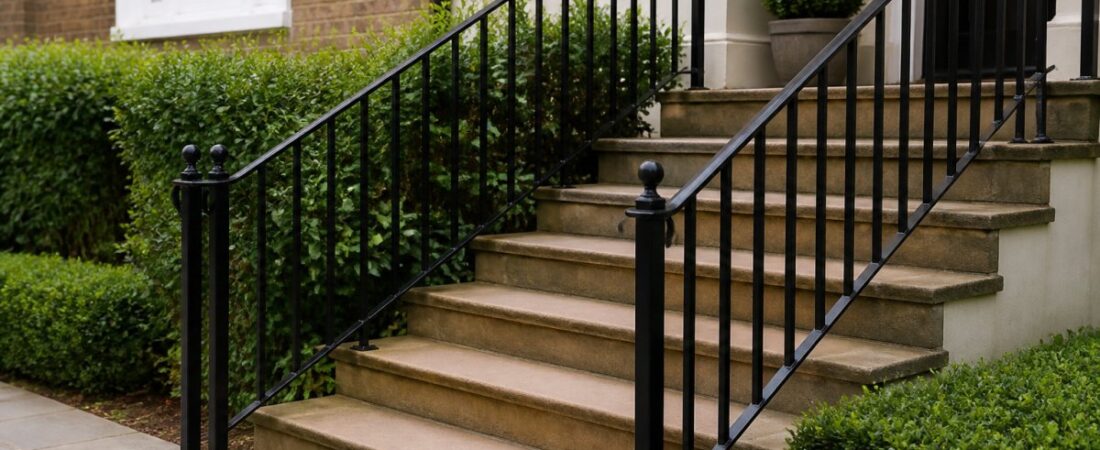
Last Updated: November 2, 2026
Quick Summary
Yes, most outdoor stairs can take an outdoor handrail, especially where there are three or more steps, uneven paving, or a change in level. Measure the height from the pitch line, usually 900mm to 1000mm, then choose galvanised, powder-coated steel and a fixing suited to the wall. Check local requirements before you fit one.
- Outdoor steps with three or more steps usually benefit from a handrail.
- Measure handrail height from the pitch line, the line joining the stair nosings.
- Most stair handrails sit between 900mm and 1000mm above the pitch line.
- Galvanised, powder-coated steel balances strength, durability and appearance for most London front steps.
- Never rely on plain plastic wall plugs for an outdoor handrail.
Table of Contents
- Do Outdoor Stairs Need a Handrail?
- Handrail Height for Stairs: Measuring It Correctly
- Outdoor Handrail Regulations in the UK
- Choosing Galvanised Steel Handrails for Outdoor Use
- How to Install an Outdoor Handrail, Step by Step
- Maintaining an Outdoor Handrail Against Rust
- Booking a Free Site Survey for Your Handrail
- Frequently Asked Questions
Outdoor stairs need a handrail, and most UK homeowners are surprised to learn how much the choice of material, height and fixing method affects both safety and longevity. At Metal Railings London, we fit galvanised and powder-coated steel handrails to front steps, side passages and garden staircases across London. Here is how to decide whether an outdoor handrail suits your stairs and what to check before you fit one.
Do Outdoor Stairs Need a Handrail?
Outdoor steps usually benefit from a handrail, particularly where there are three or more steps, uneven paving, or a change in level that someone could trip on in wet or icy weather. A handrail gives a firm point of support when the surface is slippery and when carrying shopping, bins or children.
Check whether your steps form part of a shared access route, a rental property or a commercial premises. These situations often carry stricter expectations for guarding and handrails, so confirm what applies before you choose a design.
Handrail Height for Stairs: Measuring It Correctly
Measure the handrail height from the pitch line, which is an imaginary line joining the front edges of the stair nosings. Take the measurement vertically to the top of the rail.
Most stair handrails sit between 900mm and 1000mm above the pitch line, and you should aim for a height that lets a hand rest comfortably without the wrist bending back. Measure at more than one point if your steps are uneven, because a slope or a worn step can throw off a single reading.
Fit the rail on the side that gives the most support. Where steps are narrow or the wall is uneven, a post-mounted rail can work better than a wall-mounted one.
Outdoor Handrail Regulations in the UK
Handrail requirements depend on the building, its use and any planning or building control conditions attached to your work, so it is worth confirming what applies before you commission a rail.
The documents that matter
The Building Regulations include approved documents covering guarding, handrails and access to buildings in England. Your building control team or the official government guidance will confirm which parts apply to your steps, particularly if they serve a shop, office, shared entrance or other non-domestic use.
Requirements can differ across the nations of the UK, so confirm which regime covers your address.
The figures most often quoted
Building control officers check handrails against the dimensional and strength requirements in the current official guidance, covering height, positioning, continuity, grip profile and load resistance. Confirm the exact figures for your project against that guidance before finalising your design.
When approval is likely to be needed
Building control involvement depends on the work and the property. Check with your local authority building control team before you start, particularly if you are building new steps, altering a shared access route or working on non-domestic premises. Planning permission can also apply where a property is listed or sits in a conservation area.
If your property is listed or sits in a conservation area, discuss the design with the conservation officer early. A slim, traditional wrought-iron profile is often accepted where a chunky modern section is not.
Our team can talk you through the relevant points for your property before fabrication begins.
Choosing Galvanised Steel Handrails for Outdoor Use
Galvanised steel is a practical choice for outdoor handrails because the zinc coating protects the steel from rust, which is the main threat to exterior metalwork in the UK climate. Galvanised steel can also be given a powder-coated finish, which adds colour and a further protective layer.
Stainless steel resists corrosion well and suits coastal or heavily salted areas, but it costs more and can look different from a traditional railing. Aluminium is lightweight and rust-proof but less rigid. Wrought iron offers a classic look for period properties but needs regular maintenance to stop rust taking hold.
For most London front steps, a galvanised and powder-coated steel rail gives the best balance of strength, durability and appearance. You can see our range of metal railings and our galvanised powder-coated metalwork finishes to compare options.
How to Install an Outdoor Handrail, Step by Step
A secure fixing matters more than the rail itself, because a loose handrail is a hazard. The sequence below sets out the general steps for fitting a handrail. If at any point the substrate looks doubtful, stop and reassess rather than drilling and hoping.
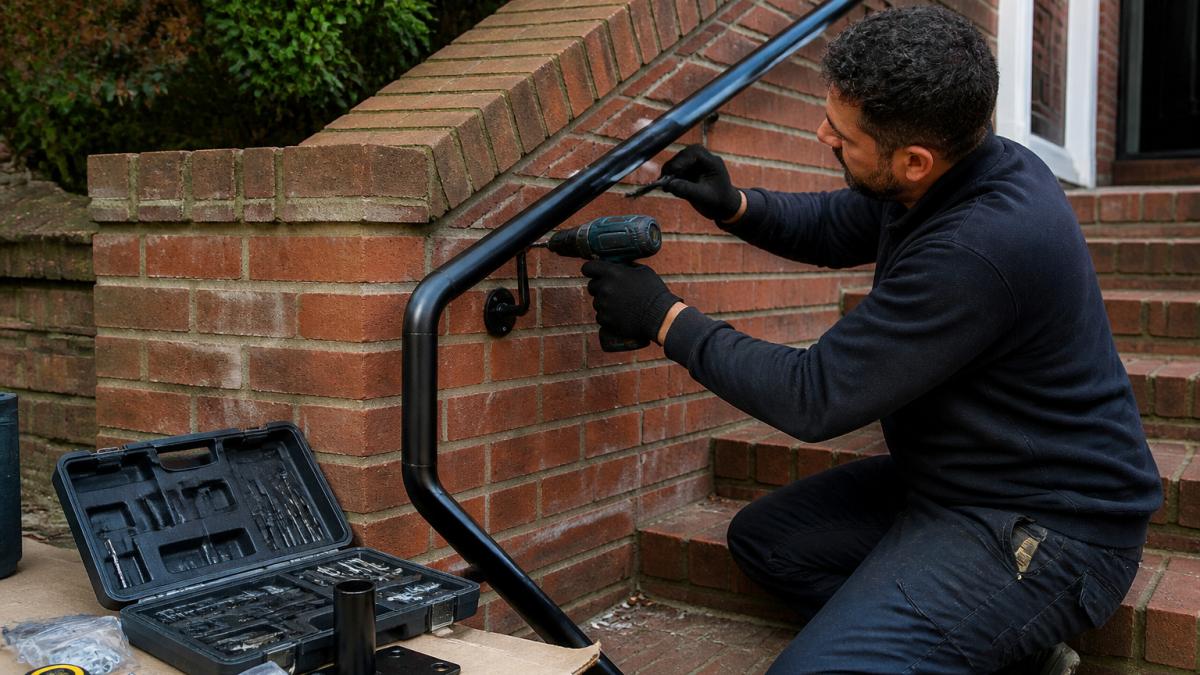
- Confirm the rail height and length. Measure from the pitch line, the line joining the front edges of the nosings, and mark the start and end points of the rail. Check the height at three points along the flight, not one.
- Set out the bracket positions. Space brackets evenly along the rail, with one close to each end. Mark them with a pencil and check them against a spirit level before any drilling.
- Identify the substrate. Tap the wall and listen for hollow sounds, which can signal loose render or a weak section. Confirm whether you are fixing into solid brick, blockwork, stone, concrete, timber or a steel post.
- Choose the right anchor for the substrate. This is where most DIY installations go wrong, see the table below.
- Drill the holes. Use the correct bit size for the anchor, drill perpendicular to the surface, and clear the dust out of each hole before inserting anything.
- Fit the anchors and brackets. Tighten each bracket firmly but do not over-torque, which can crack masonry or strip a thread.
- Attach the rail and tighten the fixings. Check the rail is level along its run and follows the pitch of the stairs.
- Load-test the finished rail. Pull firmly on it at several points along its length, in the direction someone would lean. It should not move, creak or flex at the brackets.
Matching anchors to the fixing surface
| Substrate | Typical fixing approach | What to watch for |
|---|---|---|
| Solid brick or blockwork | Masonry anchor or chemical anchor into the brick body | Avoid mortar joints, they are weaker than the brick and will pull out under load |
| Concrete | Through-bolt or resin anchor | Check for reinforcement before drilling; avoid cracking near an edge |
| Stone (including London stock and Portland) | Resin anchor, drilled carefully with a masonry bit | Stone can spall; drill slowly and avoid percussion near a face |
| Timber posts or cladding | Coach screws or structural screws into solid timber | Confirm the timber is sound and thick enough to take the load |
| Steel posts | Bolted through with suitable fixings, or welded | Check the post itself is properly footed and not just bolted to paving |
| Render or plaster over weak backing | Fix through to the solid backing, not to the render | Render alone will not hold a handrail under load |
Never rely on plain plastic wall plugs for an outdoor handrail. They are not rated for the repeated pull and lean a handrail receives, and they degrade with moisture and frost.
Common installation mistakes to avoid
- Fixing into a weak surface. Loose render, mortar joints and hollow blockwork are the most common causes of a rail that pulls out after a season.
- Uneven bracket spacing. Gaps that are too wide let the rail flex; gaps that are too tight look fussy and can crack the wall.
- Wrong rail height. A rail set too low or too high forces the wrist into an awkward angle and gives poor support on a slope.
- Over-tightening fixings. This cracks masonry and strips threads, and the rail ends up looser than if it had been tightened correctly.
- Skipping the load test. Always pull firmly on the finished rail before anyone uses the steps.
- Leaving cut ends and drilled holes untreated. Bare steel and exposed fixings rust first; touch them up before the weather gets to them.
When to call in a fabricator
If your steps are uneven, the wall is of uncertain construction, the run is long or the rail needs to follow a curve or a change in level, a fabricated rail made to measure will be safer and neater than an off-the-shelf kit. A survey of the stairs, the substrate and the fixings before anything is made helps the rail fit first time.
Maintaining an Outdoor Handrail Against Rust
Wash the rail with soapy water every few months, paying attention to the joints and the underside where moisture collects. Check for chips in the powder coating and touch them up before rust starts. Inspect the fixings once a year and tighten any that have worked loose.
A well-maintained galvanised and powder-coated rail can stay in good condition for many years.
Booking a Free Site Survey for Your Handrail
Every staircase is different, so the right handrail depends on your steps, your wall and how you use the space. You can arrange a free site survey to discuss your stairs and options. You can request a free quote for your handrail, and we will discuss the height, finish and fixing method for your project.
Frequently Asked Questions
Do outdoor stairs need a handrail?
Outdoor stairs should generally have a handrail, particularly where there are several steps, uneven ground or a change in level that someone could fall from. Handrails give users something secure to hold in wet, icy or dark conditions, when grip and balance are harder to maintain. Before fixing anything, check the current requirements for your property type and the work involved with your local authority building control team, as the rules depend on whether the stair is part of a new build, an extension or an alteration.
What is the recommended height for an outdoor stair handrail?
Handrails on stairs are commonly set at a height that lets a user grip them comfortably while walking, measured vertically from the pitch line of the stair. Using a consistent height along the whole run keeps the grip position predictable. Confirm the exact dimension against the relevant guidance in Approved Document K and British Standards before finalising your design, as requirements vary with stair type and building use.
Which material is best for outdoor stair handrails?
Galvanised steel is a strong choice for outdoor handrails because the zinc coating protects the steel from rust, and a powder-coated finish adds further protection and colour options. Stainless steel also performs well in exposed locations, while mild steel needs a protective finish to last. The best choice depends on the setting, exposure to salt or wet weather and the look you want to achieve.
How do you stop an outdoor metal handrail from rusting?
Start with a galvanised or otherwise corrosion-protected base, then apply a powder-coated finish. Check the rail at least once a year, looking for chips in the coating, flaking paint or early signs of rust at fixings and welds. Touch up small damaged areas promptly, and keep the rail clear of debris and standing water to slow corrosion.
Get a bespoke handrail for your steps with Metal Railings London. We fabricate made-to-measure galvanised and powder-coated steel, and we will give you a clear quote after the survey.
