Table of Contents
- Why Secure Parcel Drop Boxes Matter in Apartment Buildings
- Types of Parcel Boxes for Apartment Buildings
- Communal Parcel Lockers: Shared Solutions for Multi-Unit Properties
- Outdoor Parcel Drop Box Installation and Placement
- Security Features: Locks, Anti-Fishing Design, and Barcode Scanning
- Parcel Box Installation: Materials, Durability, and Building Regulations
- Sizing and Capacity: Matching Box Dimensions to Parcel Volume
- Choosing the Right Solution for Your Apartment
- Frequently Asked Questions
Last Updated: October 14, 2026
Why Secure Parcel Drop Boxes Matter in Apartment Buildings
The right parcel box reduces complaints, protects deliveries and eliminates repeated redelivery attempts. At Metal Railings London, we’ve installed secure parcel solutions across residential and commercial properties.
The challenge is finding one that fits your building’s layout, handles your volume and meets security standards.
Types of Parcel Boxes for Apartment Buildings
Parcel boxes come in three main configurations.
Wall-mounted designs
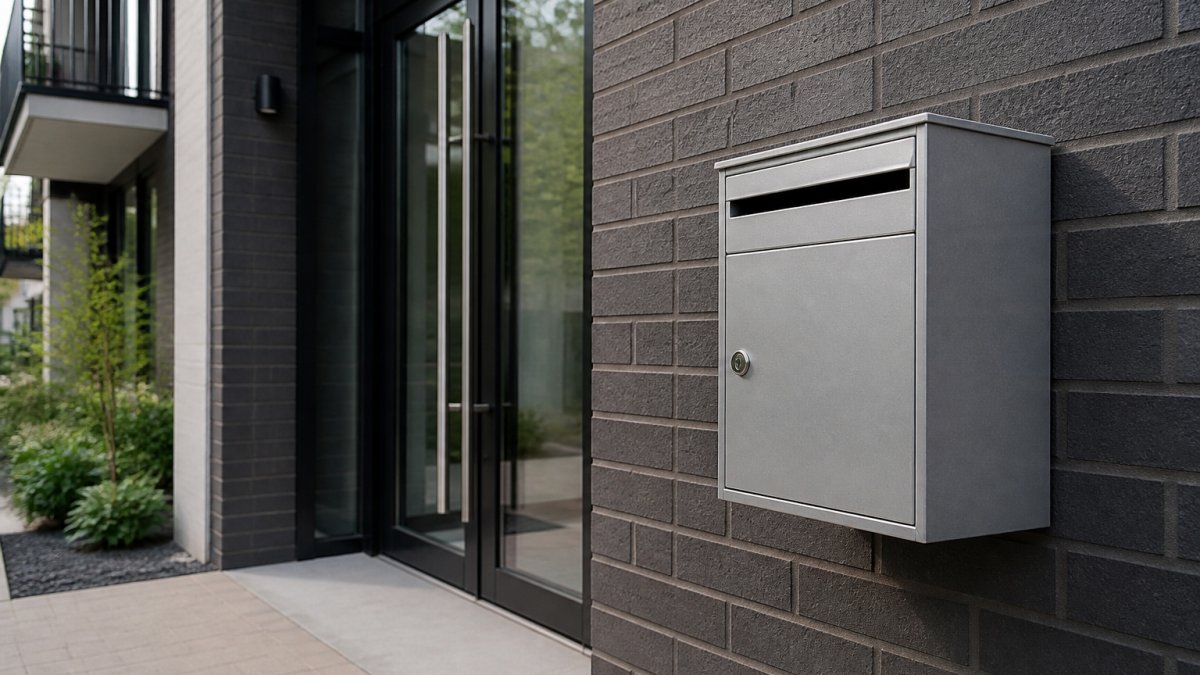
Wall-mounted parcel boxes attach directly to exterior or interior walls, ideal for buildings with limited floor space. They’re compact, don’t obstruct hallways, and sit near main entrances for easy courier access.
They suit smaller blocks or moderate delivery volumes, provided the wall supports the weight and depth.
Freestanding units
Freestanding parcel boxes stand on the ground, requiring dedicated floor space but offering greater capacity. They suit larger complexes where hallway width permits and delivery volume justifies the footprint.
They often include multiple compartments or tiers for different parcel sizes, and are easier to relocate if layouts change.
Built-in installations
Built-in parcel boxes integrate into the building structure, recessed into walls, set within entrance vestibules, or part of a security entrance system.
They require planning during renovation or new construction, and suit modern developments or major refurbishments where the box is specified alongside other entrance features.
Communal Parcel Lockers: Shared Solutions for Multi-Unit Properties
For larger apartment buildings, communal parcel lockers are a step up from basic drop boxes, letting multiple residents access their own compartments using individual keys, codes or smart locks.
Access control and resident permissions
Communal lockers need a system ensuring only the intended recipient retrieves each package. Key-based systems are simple but require key distribution and replacement when lost.
For apartment managers, access control also means preventing residents from accessing other residents’ parcels. Individual compartments with secure locks are essential.
Capacity planning for shared buildings
A 50-unit building might receive 15-30 parcels on an average day.
Capacity planning requires honest assessment of delivery frequency.
Multiple smaller lockers distributed across the entrance are often more practical than one large unit, improving access and reducing queuing.
Outdoor Parcel Drop Box Installation and Placement
Outdoor parcel boxes must withstand weather and remain secure in an exposed environment. Installation location and material choice are critical.
Weather resistance and waterproofing
Outdoor parcel boxes face rain, wind, temperature swings and UV radiation. Galvanised steel is the standard material, resisting rust and corrosion for decades with minimal maintenance, while a powder-coated finish adds durability and matches building aesthetics.
Waterproofing isn’t just external; internal drainage matters too. A well-designed box has slight internal slopes and drainage holes to prevent pooling, with seals around the aperture and door closure keeping rain out when closed.
For exposed locations or heavy rainfall, consider boxes with reinforced door seals and stainless steel hinges.
Delivery driver access and parcel drop-off
The parcel aperture must be large enough for typical parcels but small enough to prevent theft.
Internal design matters equally. Anti-fishing locks stop anyone reaching through the aperture, while a secure internal baffle or angled shelf means parcels fall safely inside and can’t be pulled back out.
Couriers need clear visibility and easy access.
Security Features: Locks, Anti-Fishing Design, and Barcode Scanning
Security is the core function of a parcel box. Multiple layers, locks, internal design, and access control, work together to prevent theft and unauthorised access.
Key, combination, and smart locking mechanisms
Key locks are simple and reliable but require physical key management: residents need copies, and lost keys mean replacement or rekeying.
Combination locks let couriers deposit without a key, but residents must remember codes. Digital combination locks can be reprogrammed between deliveries, so a stolen or shared code only works once.
Anti-fishing locks and secure parcel aperture design
Anti-fishing technology prevents anyone inserting a tool through the aperture to hook out a package. A secure aperture includes:
- A baffle or internal deflector that redirects packages downward and inward
- A narrow slot that only allows forward insertion, not retrieval
- An internal compartment separated from the aperture by a barrier
The best designs combine a small aperture with a wide internal chamber: couriers insert through a tight opening, but the parcel falls into a larger secure space that can’t be reached from outside.
Parcel Box Installation: Materials, Durability, and Building Regulations
Installing a parcel box in a block of flats is rarely as simple as drilling four holes in a wall. In a communal area you are working in a space governed by fire strategy, accessibility expectations and the building’s own management rules, and getting any of those wrong can mean removing the box and starting again.
Materials and finishes that survive a communal entrance
Galvanised mild steel is the workhorse for outdoor parcel boxes. The zinc layer sacrifices itself to protect the underlying metal, giving a service life commonly measured in decades depending on exposure.
Stainless steel, typically 304 or 316 grade, suits genuinely corrosive settings, coastal salt spray, heavy road-salt exposure or industrial atmospheres. For most London locations a galvanised and powder-coated box is a sensible balance.
Fixing methods and structural checks
Wall-mounted boxes must be fixed into solid structure, brick, block, concrete or steel frame, not plasterboard or dry-lined partition.
Freestanding units need a level, load-bearing base. A concrete plinth or paving slab bedded on a solid sub-base prevents settling and twisting, which causes doors to drop and locks to misalign.
Fire safety and escape routes
Building Regulations Part B (Fire Safety) governs communal areas, and nothing you add may obstruct an escape route, fire door, protected lobby or the clear space in front of a final exit.
Fire doors are a particular trap: never fix a box to a fire door or its frame, and never let one prevent a self-closer from shutting fully.
Accessibility and reach ranges
Communal entrances serve everyone, including wheelchair users, people with pushchairs and older residents.
The space in front needs a clear, level approach of at least 1200mm so a wheelchair or mobility scooter can turn and reach. Where there’s a step or threshold, the box shouldn’t force the user to balance on an incline.
Electrical work and Part P
Smart locks, keypads, intercoms and powered doors are electrical installations.
Where a smart system needs a network connection, plan the cable route and power supply at survey stage. Retrofitting power to a lobby that has no spare circuit is one of the most common reasons a smart locker project stalls.
Landlord, freeholder and building control approval
Even where installation is physically straightforward, permission is often the longest lead item.
For anything affecting the structure, fire strategy or external appearance of a listed or conservation-area building, building control or planning consent may be needed. Listed building consent is separate from planning permission and covers alterations affecting a listed building’s character, including some external metalwork.
Before you order anything, walk the proposed location with the building’s responsible person and agree three things in writing: the exact fixing point, the fire strategy impact, and who is authorised to commission the box. That single conversation prevents most of the problems we see on retrofit jobs.
If you would like us to assess a communal entrance and advise on fixing, fire compliance and finish, we offer a free site survey across London and the surrounding areas.
Sizing and Capacity: Matching Box Dimensions to Parcel Volume
Most parcel box guidance stops at “buy a bigger one”. In a shared building the real constraints are how many residents collect at once, the size mix of what arrives, and what happens when the box is full. This section sets out a practical way to size a system for a block of flats.
Start with a delivery profile, not a parcel count
Before choosing compartments, build a simple profile of your building:
- Resident count and occupancy pattern. 40 one-bedroom flats with short-term tenants generate a very different profile from 40 family-sized flats with long-term owner-occupiers.
- Typical daily parcel volume. Ask regular couriers and Royal Mail about volumes for your postcode. Dense urban blocks commonly see roughly one parcel per two to three residents per weekday, rising sharply before December and during major sales events.
- Size mix. Most parcels are small, shoebox to medium carton. A minority are large or bulky, and those cause overflow.
A simple sizing method
A workable starting point is to size the system so compartments at least equal the expected peak-day parcel count, not the average.
Compartment size matters as much as count. Many small compartments look generous on paper but fail the moment a large carton arrives. A practical mix for a residential block is roughly:
- Around 70% small/medium compartments for the everyday parcel
- Around 20% large compartments for bulky but not oversized items
- Around 10% oversized or shared compartments for the occasional very large delivery
Where there’s a concierge or managed reception, oversized parcels can be diverted there. Where there isn’t, the oversized compartment is the pressure valve that keeps the rest of the system working.
Distributed versus centralised systems
A single large bank of lockers at the main entrance is efficient to install and service, but concentrates footfall and can create queues at peak collection times.
For buildings with more than one core, a distributed approach is usually the better resident experience; for a single-core building, a centralised bank with a clear collection area is normally right.
What happens when the box is full
Every system needs a documented full-box procedure, because it will happen. The options are:
- Overflow compartment. A designated oversized or shared compartment for when standard compartments are occupied.
- Concierge or reception. Divert to a staffed point during working hours.
- Return to depot. The courier takes the parcel back and a redelivery or collection is arranged, least popular with residents, so a last resort.
Whichever route you choose, communicate it to residents and, ideally, the regular couriers. A full-box procedure only the property manager knows about doesn’t solve the problem.
Returns and reverse logistics
Outbound returns are the forgotten half of capacity planning. A resident returning an online order needs somewhere to leave it, and that parcel occupies space in the same system. If returns are frequent, common in fashion and electronics, the system needs a dedicated outbound slot or a clear process for handing returns to a courier or a local collection point.
Sizing checklist
- Count residents and note the occupancy pattern.
- Estimate average and peak daily parcel volumes with courier input.
- Map the size mix of typical deliveries.
If you are unsure how to size a system for your building, we can survey the entrance, review your delivery profile and recommend a compartment mix as part of a free consultation.
Choosing the Right Solution for Your Apartment
Consider the access method. For small buildings with tech-savvy residents, a smart lock system is worth the investment.
Finally, think about maintenance and longevity. Galvanised and powder-coated steel requires minimal upkeep, occasional cleaning is enough.
At Metal Railings London, we design and install secure parcel boxes tailored to your building’s layout, security needs and aesthetic requirements.
Frequently Asked Questions
What is the best way to secure parcel deliveries in an apartment building?
Secure parcel drop boxes provide the most reliable protection against theft and weather damage. Choose a solution with anti-fishing locks, weatherproof construction, and clear resident access procedures. For communal buildings, assign specific compartments to each flat and ensure delivery drivers understand the access protocol. Wall-mounted or built-in units save space and integrate seamlessly with your building’s entrance.
Are parcel drop boxes suitable for blocks of flats?
Yes, parcel boxes work exceptionally well for apartment blocks. Communal parcel lockers reduce missed deliveries and protect packages from weather and theft. They work best when sized to match your building’s typical parcel volume and installed near the main entrance for convenient delivery driver access. Multi-unit buildings benefit from clearly labelled compartments and straightforward locking systems that residents can operate quickly.
What materials should I choose for an outdoor parcel drop box?
Galvanised steel is the industry standard for outdoor parcel boxes. It resists rust and corrosion in all weather conditions and meets durability requirements for long-term outdoor use. Powder-coated finishes add aesthetic appeal while protecting the base metal. Both finishes comply with UK Building Regulations and maintain their integrity for years with minimal maintenance, making them ideal for secure delivery protection.
How do I ensure parcel box installation complies with building regulations?
Installation must consider fire safety, accessibility, and structural integrity. Wall-mounted units require proper anchoring to structural elements; freestanding boxes need secure positioning on level ground. Check local building control requirements before installation, particularly regarding emergency access routes and fire escape compliance. A professional fabricator experienced in bespoke metalwork will ensure your installation meets all regulatory standards and integrates safely with your property’s existing structure.
Package theft and missed deliveries frustrate residents and create operational headaches for property managers. A properly specified secure parcel drop box eliminates both. Metal Railings London combines galvanised steel construction, anti-theft design, and bespoke installation to deliver a solution that fits your building perfectly. Get in touch for a free site survey and quote, we’ll assess your space, understand your delivery patterns, and recommend the right system for your needs.