Last Updated: October 26, 2026
Quick Summary
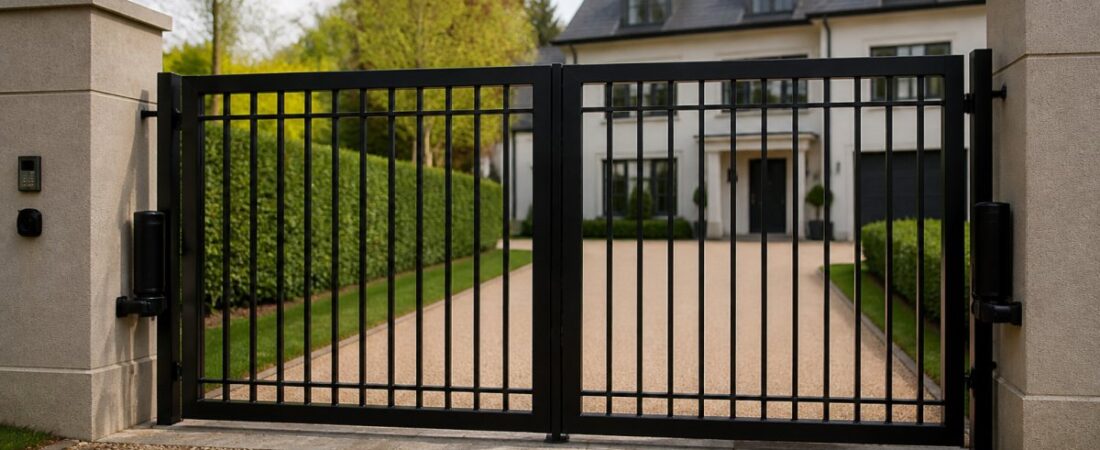
Secure metal driveway gates combine strong materials like galvanised steel with design features that resist forced entry, including effective climb height of 2.0-2.4 m, vertical bar spacing of 100-120 mm centres, multi-point locking systems, non-removable hinge pins, and posts set at least 1.2 m into reinforced concrete.
- Galvanised steel resists corrosion in the UK climate when coated with zinc through hot-dip galvanising, then powder-coated for additional protection.
- Swing gates are the practical choice for most residential driveways because they have fewer moving parts, work manually if power fails, and are easier to service than sliding gates.
- Bar spacing of 100-120 mm centres prevents hands and tools reaching through to latches; gaps wider than 200 mm compromise security.
- Multi-point locking with a central lock plus top and bottom throw bolts resists prying at the gate edges far better than a single central latch.
- Automated gates must include force limitation, presence detection, safety edges, warning signage, and a manual release to comply with BS EN 12453 and prevent crush hazards.
Table of Contents
- Why Security Starts with Material Choice
- Steel Driveway Gates: Strength and Durability
- Swing Gates versus Sliding Metal Driveway Gates
- Galvanised Metal Gates: Protection Against the Elements
- Automated Driveway Gates and Access Control
- Design Features That Enhance Security
- Getting Your Secure Metal Gate Installed
- Frequently Asked Questions
Why Security Starts with Material Choice
A secure metal driveway gate begins with the material you choose. Steel, wrought iron, and stainless steel each offer different levels of strength, durability, and weather resistance. Explore the full range of metal driveway gate solutions to see how these materials are applied to custom designs for your property.
Mild steel without proper protection rusts within years in the UK climate; stainless steel resists corrosion naturally but costs more; wrought iron is only strong long-term if properly galvanised or powder-coated to prevent oxidation.
UK Building Regulations on structural safety for barriers require that gates meet specific strength standards, particularly for commercial and multi-unit residential properties. Understanding these standards helps you choose materials that won’t just look secure, but will actually perform under stress.
Steel Driveway Gates: Strength and Durability
The key to steel durability is the finish applied after fabrication.
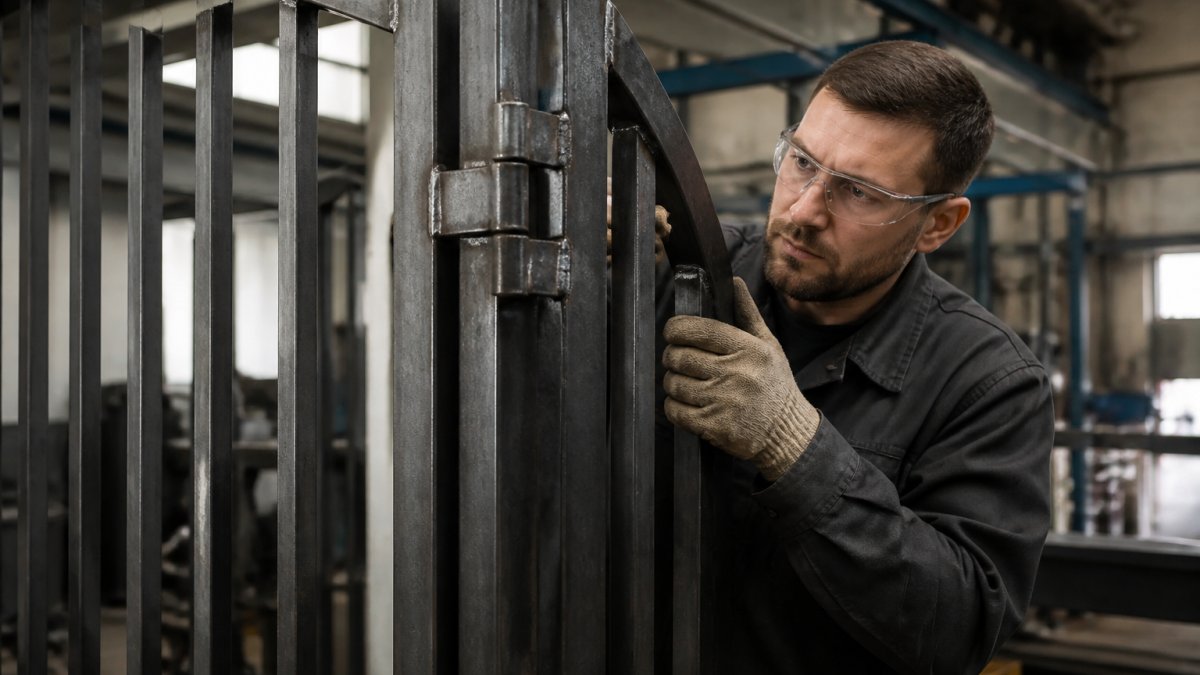
Powder coating adds another layer of protection. Applied after galvanisation, it provides colour and additional weather resistance.
Steel gates can be fabricated in virtually any size or design, from narrow pedestrian gates to wide driveway entrances.
One practical consideration: steel gates are heavier than aluminium alternatives, which matters if you plan to automate them later.
Swing Gates versus Sliding Metal Driveway Gates
Whether your gate swings or slides affects both security and practicality, and each approach has genuine trade-offs.
Swing gates open inward or outward on hinges, like a traditional door, and are the most common choice for residential driveways.
Swing gates do require space to open fully.
For secure metal driveway gates in most residential settings, swing gates remain the practical choice.
Galvanised Metal Gates: Protection Against the Elements
Galvanisation transforms a steel gate from a rust-prone liability into a durable asset.
Galvanised metal gates have a zinc coating applied through hot-dip galvanising, where steel is immersed in molten zinc. The zinc bonds metallurgically to the steel surface, creating a barrier that protects the underlying material.
In the UK’s climate, with salt spray near coastal areas and regular moisture inland, galvanisation is not optional for long-term durability.
Coating thickness matters: for gates, a sufficient thickness is important for effective protection.
After galvanisation, powder coating adds colour and UV protection.
You can explore the full range of metal driveway gate solutions offered by Metal Railings London to see how galvanised finishes are applied to custom designs.
Automated Driveway Gates and Access Control
Automation adds convenience and security to a metal driveway gate, allowing remote control, integration with access systems, and electronic monitoring.
Automated driveway gates use electric motors to operate swing or sliding mechanisms. The motor receives a signal from a remote control, keypad, or smart system.
Reliable automation depends on quality components: motors rated for frequent cycling, heavy-duty hinges, and strong control systems.
Design Features That Enhance Security
Most gate buying guides describe security features in isolation. What actually helps is comparing designs against each other, because every security decision is a trade-off. The five variables below determine how hard a gate is to climb, force, see through, or lift off its hinges.
Height and climbability
A gate’s effective security height is not its physical height but the height of the last foothold plus a person’s reach. A 1.8 m gate with horizontal rails every 150 mm is, in practice, a ladder; one with vertical bars at 110 mm centres and no horizontal footholds below 1.5 m is very different. As a rule of thumb, gates under 1.8 m deter casual intrusion, gates of 2.0-2.4 m with anti-climb infill deter determined attempts, and anything above 2.4 m usually needs planning consideration.
Infill spacing and what it lets through
Bar spacing is the most misunderstood security dimension. Gaps wider than about 100 mm let a hand and wrist through to reach a latch, lock, or hinge; gaps wider than about 200 mm let a shoulder or tool through. For genuine security, vertical bar centres of 100-120 mm are the practical standard, decorative scrollwork often looks denser than it is once measured.
Open versus solid infill: the real trade-offs
This is where most guides stop at “solid is more private.” The full comparison:
- Visibility. Open bars let neighbours and passers-by see your driveway, which is itself a deterrent. Solid infill hides your vehicles and property from casual view but also hides an intruder from the street.
- Climbability. Solid infill offers no footholds but presents a flat surface that can be scaled with a ladder leaned against it. Open bars with wide spacing offer footholds; open bars with tight spacing and no horizontals offer neither.
- Wind loading. A solid gate is a sail. On an exposed site, a 3 m wide solid gate can transmit substantial force to posts, hinges, and motors. Open infill sheds wind and is far kinder to the structure and to automation.
A common professional compromise is solid infill in the lower 1.2 m (where forced entry and prying concentrate) with open vertical bars above for visibility and wind relief. Learn how custom design choices contribute to gate security by balancing these competing demands.
Locking points and latch design
Security is limited by the weakest locking point. A single central latch on a 3.5 m double gate can be pried at the leading edge; better designs use a central lock plus top and bottom throw bolts, or a multi-point system engaging the frame at three or more points. The lock should be recessed, not surface-mounted, and the latch shielded so it cannot be slipped from outside.
Hinges and lift-off resistance
If hinge pins are accessible from outside, the gate can be lifted off entirely, no lock required. Security hinges use non-removable pins, or are mounted on the interior face so pins cannot be driven out. On double gates, the meeting stiles should overlap or interlock so the leaves cannot be forced apart.
Posts and attachment points
The gate is only as strong as what it is fixed to. Posts should be set at least 1.2 m into the ground in reinforced concrete, sized to the gate’s weight and wind load, and braced against the direction of force. A heavy gate on undersized posts will move before the gate fails.
Compare any two gate designs on five measures: effective climb height, clear bar spacing, reach-through risk, number of locking points, and hinge lift-off resistance. A gate that scores well on all five is genuinely secure; one that scores well on appearance alone is not.
Security depends on how a gate performs across five key design measures.
| Security measure | What it controls | Standard for security |
|---|---|---|
| Effective climb height | Casual versus determined intrusion | 1.8 m deters casual; 2.0-2.4 m deters determined |
| Bar spacing | Hand, shoulder, or tool reach-through | 100-120 mm centres; avoid gaps over 200 mm |
| Locking points | Prying resistance at edges | Central lock plus top and bottom throw bolts |
| Hinge design | Lift-off resistance | Non-removable pins or interior-mounted |
| Post depth and bracing | Gate stability under force | At least 1.2 m into reinforced concrete |
Getting Your Secure Metal Gate Installed
Installation is where design, materials, and regulation meet reality. A poorly installed gate will fail prematurely, may not perform its security function, and, if automated or opening onto a highway, may not comply with the requirements that apply to it. This section covers practical fitting plus the UK safety and planning points most guides omit.
Practical installation considerations
Professional installation ensures the gate hangs true, operates smoothly, and performs its security function. Core steps:
- Setting posts at the correct depth in properly compacted, reinforced concrete foundations
- Aligning hinges so the gate swings without binding or sagging under its own weight
- Fitting latches and locks so they engage fully across the gate’s travel
Driveway slope, ground conditions, and proximity to walls or trees all affect complexity. A steep driveway needs deeper, more heavily braced posts; clay or rocky ground may need wider excavation; a gate close to a wall needs hinge and swing clearance planned before fabrication.
Planning permission and permitted development
In England, gates, fences, and walls are generally permitted development up to 2 m high, or up to 1 m where they adjoin a highway. Above those heights, planning permission is usually required. Conservation areas, listed buildings, and Article 4 directions remove or restrict permitted development rights, so a gate acceptable elsewhere may need consent. Always confirm with the local planning authority before commissioning a tall or solid gate, many London streets are conservation areas.
Gates opening onto or near a highway
A gate that opens outward over a highway, footway, or verge raises access and safety questions. The general expectation is that gates open inward, away from the highway, so they do not obstruct pedestrians or traffic. Where outward opening is unavoidable, the gate should be set back so it does not swing over the highway, and the local highway authority should be consulted, especially on tight urban frontages.
Automation safety
Automated gates are machinery and carry specific safety obligations. The relevant standard for powered gates is BS EN 12453, with installation guidance in BS EN 12445 and the supporting code of practice. In practice:
- Force limitation so the gate stops and reverses if it meets an obstacle
- Presence detection, typically safety edges on the closing edge, plus photocells or radar across the opening
- Clear warning signage on or near the gate
A gate automated without these measures is not just non-compliant; it is a genuine crush hazard, particularly for children and pets. Ensure any automation is commissioned and tested by a competent installer, and keep the test records.
Access, turning, and vehicle clearances
Security and access pull in opposite directions: a gate wide enough for a delivery van is also wide enough for an intruder’s vehicle. Plan the opening around the largest vehicle that genuinely needs access, allow mirror-to-mirror clearance and turning space on the approach, and consider a separate pedestrian gate so the main gate need not be opened for foot traffic.
What to expect from a professional installation
A proper installation includes a site survey, confirmation of post positions and foundation depths, a check on planning and highway considerations, commissioning and force-testing of any automation, and a handover explaining manual release, maintenance, and record-keeping. Get a free quote and consultation to discuss your driveway conditions, planning position, and access needs with our team.
Request a free site survey and consultation to discuss your driveway conditions, planning position, and access needs, and to get a realistic assessment of what is involved in creating a secure metal driveway gate for your property.
If your gate will be automated, do not accept a handover without force testing, safety edges, presence detection, warning signage, and a working manual release. These are safety requirements, not optional extras.
Frequently Asked Questions
What is the most secure type of metal driveway gate?
Solid steel gates with minimal gaps in the infill offer the highest security, as they prevent visibility into the property and resist forced entry. Solid construction combined with heavy-duty hinges, quality locks, and galvanised or powder-coated finishes provides comprehensive protection. The strength of the frame and the quality of the installation matter equally, a well-fitted gate with secure posts will outperform a flimsy design regardless of material choice.
Should I choose a sliding metal driveway gate or a swing gate for security?
Both designs can be equally secure if properly installed. Swing gates suit narrower driveways and offer easier manual operation; sliding metal driveway gates work better where space is tight or where you need a wider opening. Security depends on the locking mechanism, frame strength, and installation quality rather than the configuration. Consider your driveway layout, access frequency, and whether automation will be added when deciding between the two.
Do galvanised metal gates actually resist rust better than powder-coated finishes?
Galvanised metal gates use a zinc coating applied through hot-dip galvanising, which provides excellent rust resistance in most environments. Powder coating adds a decorative layer but requires the underlying metal to be properly prepared first. Many secure metal gates combine both: a galvanised base for corrosion protection plus powder coating for colour and additional durability. The combination offers superior protection in harsh weather and extends the lifespan significantly.
Can automated driveway gates improve security compared to manual gates?
Automated driveway gates add convenience and control, you can lock the gate remotely, restrict access to authorised users, and monitor entry points. However, the security benefit depends on the quality of the access-control system and the physical strength of the gate itself. A poorly maintained automated gate offers no advantage over a well-installed manual gate. Automation works best when combined with solid construction, quality locks, and proper installation to create a complete security solution.
